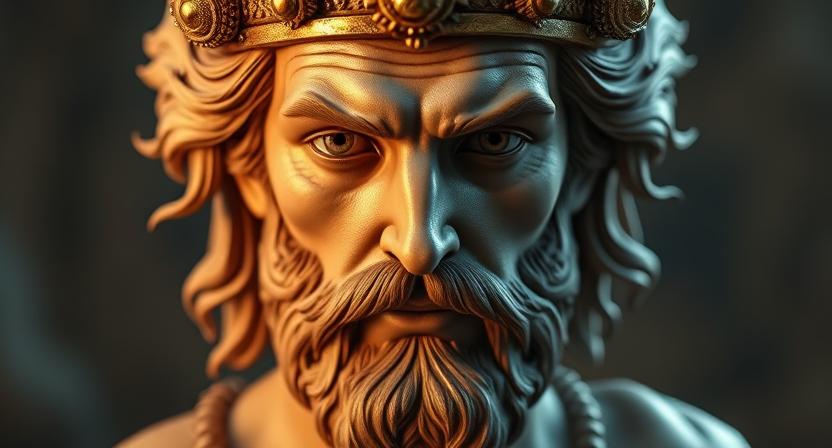
- God of Wine, Vegetation & Drunkenness
- God of Ritualistic Frenzy & Madness
- God of Religious Ecstasy
Dionysus (Greek)
In Greek Mythology, Dionysus is the son of Zeus, the god of wine and vegetation and instructs humans on how to cultivate grapes and make wine. He’s also the god of ritualistic frenzy, theater and religious ecstasy, which I personally find to be an odd combination. Dionysus is depicted wearing a crown of ivy and wielding a staff, wound with ivy leaves. He specializes in driving humans insane and associates himself with Pans, Satyrs and Bacchic women. This ancient figure’s a mystery god, who’s usually revealed as heavily robed. He’s robed to conceal his both male and female attributes. Dionysus is a true androgyne (Productions 2018, Min 41). This god is always depicted as a bearded elder or effeminate youth. Effeminate male youth were intricately woven, almost unnoticed, into the Greek and Roman cultures; typically always serving the adepts, those in high positions. The same happens today in many cultures, throughout politics, theater (Hollywood), business, military and others. While most hide it, some movements outwardly display their agenda, while denying it, such as the LGBTQ Movement which intends to legalize pedophilia.
Dionysus is one of the Olympian Deities, a demigod. This figure is dismembered and reassembled, just as the Egyptian Osiris, a recurring theme in mythology throughout all cultures of the world at all times throughout history. How all ancient cultures, existing at different times in history and without knowledge of each other, could value the same themes throughout their belief systems seems impossible to this writer. The dismemberment and reassembling of these gods, symbolizes the body of knowledge (Seven Sacred Sciences, the stolen and hidden knowledge of ancient societies) God Almighty “spread-out” through time and beyond; of which, the occult intends to reassemble in their efforts to defeat the God of all Creation and win their freedom from His wrath and judgement on The Great Day of the Lord.
Bacchus (Roman)
Bacchus is the son of Jupiter (The Roman equivalent to the Greek god Zues) and is characterized as the god of wine and cheer. Festivals are held in his honor by his worshippers, whether knowingly or unknowingly and, ultimately, wine and cheer become drunkenness and frenzy. Modern Mythologists (Mythology, one of the Seven Sacred Sciences, once taught in the public school system in Western Civilization) recognize Moses (Gnostic blasphemy) as both Osiris and Bacchus. (Fleming, 2017. Pg. 3).
Bacchus dies each winter and is reborn in the spring. His rebirth’s a direct blasphemy of Jesus Christ’s Resurrection; of which, God only has to accomplish once, where Bacchus has to rebirth annually, continually, to display his divinity to his followers. Bacchus’ annual resurrections embody the promise of the occult’s doctrine of the resurrection of their dead. He uses God’s divine order (seasons changing, harvesting food) to accomplish this ruse on mankind. His historic, female followers, the wild-haired Bacchae, wore ivy crowns and fawn or goatskins on their left shoulders, and they carried thyrsus staffs wound with ivy. The Ivy plant is symbolic of Bacchus.
Dionysus/Bacchus in Modern and Historical Education System:
Illuminated Fraternities of the Seven Sacred Sciences consider those without their knowledge mundane, vulgar, and ignorant people; chattel, the equivalent to animals, if you will. Humans are controlled by an academic system, which feeds it’s lower-level students, controlled information to procure them for its purposes. At the end of the learning experience, these vulgar graduates are therefore, rewarded with a ceremony (graduation) and given a degree (bachelor’s degree), of which, the origin of the name derives from the god Bacchus. The ceremony itself is a ritual, enslaving the mundane chattel into its system while giving them a semblance of success and achievement.
As a ritual, by means of the graduation ceremony, graduates have been admitted into the realm of control, or the “larium” of Bacchus and achieve the status of “baccalaureus.” The word “Larium” is of Etruscan origin. Its Roman word equivalent is “Laurel.” In these, one would keep a miniature shrine known as a lararium to the god of the household and use the term “lares” to describe its place. The modern English form of this word is “lair,” as in a “Dragon’s Lair” (M. A. Flynn 2014, 259). These Larium/Laurel/Lare/Lairs were used to indicate smaller personal areas having a ruling deity, such as a god over a household. Ironically enough, the universities who produce the highest level of quality mundane chattel are considered “Ivy-League Schools.”
AKAs and Intercultural Connections:
- Osiris – Egypt
- Dionysus – Greek
- Phanoesus (Mysians of Asia Minor)
- Bacchus – Roman
- Liber (Roman)
- Adonis (Ba’al) – Arabia

Sources:
- Productions, Shaking My Head. YouTube. 12 09, 2018. https://www.youtube.com/watch?v=ONe1LyesrHI&t=2398s (accessed 03 10, 2020).
- Fleming A.B., Rev. John. The Fallen Angels and the Heroes of Mythology. Originally published by Hodges, Foster, and Figgs, Publishers to the University in Dublin, 1879; reproduced by Defender Publishing, Crane: MO, 2017
- Flynn, Mark A. Forbidden Secrets of the Labyrinth: The Awakened Ones, The Hidden Destiny Of America, And The Day After Tomorrow. MO: Defender Publishing, 2014.
 The Truth Project of Salisbury Md.